Filament Storage and Drying: The Complete Guide

Water is the invisible defect
Every common filament is hygroscopic — it drinks water vapour from the room. Nylon and TPU drink fastest, PETG steadily, PLA slowest but surely. Inside a 210 °C nozzle, that water becomes steam instantly, and the steam does four kinds of damage: it pushes plastic out uninvited (stringing and blobs), it leaves craters and a matte, rough surface, it weakens layer bonding as bubbles interrupt the weld, and on long prints it can spit and pop audibly. The cruel part is that wet filament imitates other faults — owners re-level beds and re-tune retraction for a problem that lives in the spool.
Quotable fact: PETG can absorb enough moisture in a few humid weeks to print visibly worse; nylon can do it in a single day left out in damp air.
The diagnostic is simple: listen. Popping, crackling or hissing at the nozzle, plus a suddenly rough surface on a spool that used to print clean, means dry first and troubleshoot second.
Drying: temperatures and times that are safe
Drying means holding the spool warm enough, long enough, for water to leave the plastic — without softening the plastic itself. Stay below each material's softening point and give it time; hotter is not better if the spool warps.
- PLA: 45–50 °C for 4–6 hours.
- PETG: 55–65 °C for 4–6 hours.
- ABS / ASA: 60–70 °C for 4–6 hours.
- TPU: 50–55 °C for 4–5 hours — it drinks fast, dry it often.
- Nylon: 70–80 °C for 8–12 hours, and print it straight from a dry box.
A dedicated filament dryer is the tidy answer and doubles as a print-from-it dry box. A food dehydrator with the trays cut out works well. A kitchen oven is the risky option — many cannot hold 50 °C steadily and overshoot on the way there, which can fuse a spool's windings together; if you use one, verify with an oven thermometer and babysit the first run. Your printer's own heated bed with a cardboard box over the spool is a legitimate budget dryer at 45–55 °C.
Storage: the dry box system
Drying is the rescue; storage is the cure. The system that works is boring and cheap: an airtight box or heavy zip bag per spool (or one big gasketed tub for several), a generous handful of rechargeable silica gel desiccant inside, and a cheap hygrometer so you can see the humidity instead of believing in it. Aim for under 20% RH in the box; under 15% is better for PETG and nylon. When the silica gel changes colour or the hygrometer creeps up, recharge the desiccant in an oven or microwave per its instructions and carry on.
Habits matter more than hardware. Take out one spool at a time, reseal the box immediately, and put the spool back the day you finish with it — not next week. Vacuum bags with a valve are excellent for the spools you print rarely. And write two dates on each spool with a marker: when it arrived, and when it was last dried. Three months from now you will thank yourself.
What drying cannot fix
Honesty corner: drying reverses moisture damage, but it is not resurrection. Filament left wet for many months can hydrolyse — the polymer chains themselves break — and no drying restores its strength; it will print brittle forever. Sunlight does similar permanent damage. And some 'wet filament' symptoms are actually a dying nozzle or a slipping extruder wearing a disguise. Dry the spool as step one because it is cheap and often decisive — then, if the fault survives, work the relevant guide: stringing, first layer, clogs. Wondering how much printable filament is left on a dried spool? The spool remaining estimator answers by weight.
How wet is too wet? Measuring instead of guessing
You cannot see moisture in filament, but you can weigh it — and weighing turns superstition into data. A spool that has absorbed water is measurably heavier: mark a new spool's weight on its label (spool and all), and weigh it again when prints degrade. A gain of even 3–5 g on a part-used spool is water you can drive back out. Pair that with the hygrometer in your storage box and you have the two numbers that run the whole system: box humidity under 20% RH, and spool weight stable.
There is also a printer-side witness. Many slicers and printers report extrusion consistency indirectly through surface quality, but your ears are better instruments: the crackle-pop of steam at the nozzle is water leaving violently, and it is unambiguous. Dry at the first crackle, not after the third failed print. The spool estimator uses the same scale you already own for this — one kitchen scale quietly runs half the quality control in a home print shop.
Material-by-material storage reality
Not all spools are equally thirsty, and your storage effort should be spent where the thirst is. Nylon is the emergency: it can absorb print-ruining moisture in under a day of open air and should live in, and print from, a dry box permanently. TPU is nearly as thirsty and far more common in beginner hands — the 'TPU always strings' myth is mostly 'TPU is always wet'. PETG is the steady drinker that fools people: fine for a fortnight, quietly worse by the month, and the most common true cause of 'my printer changed' complaints.
PLA is the camel — slow to absorb, and in a dry heated home it can sit out for weeks without drama, which is exactly how bad habits form before a humid summer arrives. ABS and ASA sit between PETG and PLA. The practical system: one good dry box for whatever is open, vacuum bags for the archive, and a dryer that earns its shelf space the first time it resurrects a spool you were about to bin. Spend on storage before you spend on a second printer; dry filament on a modest machine outprints wet filament on a flagship, every single week of the year.
The freezer trick, vacuum bags and other folk wisdom — graded
Beginner communities trade storage folklore, and some of it deserves grading. Vacuum bags with desiccant: genuinely excellent — A grade, the closest thing to pausing time for a spool. Rice as a desiccant: works weakly and dusts your filament with starch — D grade; silica gel is cheap and rechargeable. The freezer: a persistent myth — cold air holds little moisture, but a spool moved from freezer to warm room condenses water onto itself, achieving the opposite of the goal — F grade, do not.
Printing straight from the dryer deserves its A grade for nylon and TPU: a heated dry box feeding the printer means the spool never re-enters room air mid-print, and long prints stop degrading in their final hours — a real effect on big TPU and nylon parts that owners often misread as a printer fault appearing late in prints. And the humblest winner: the marker pen. Date every spool on arrival and after every drying. Moisture problems are timeline problems, and the pen is how you read the timeline.
The two-spool rule for beginners
If the full dry-box system feels like a lot for week one, adopt the two-spool rule and grow from there: only two spools are ever 'open' — the one on the printer and one in a sealed bag or box with desiccant — and every other spool stays factory-sealed until it is promoted. It caps your exposure, makes the timeline pen-and-label habit trivial, and matches how beginners actually print: one everyday PLA and one colour or material for the weekend project. Most moisture disasters happen to the fifth open spool that nobody remembers opening. Scarcity, deliberately applied, is a storage technology.
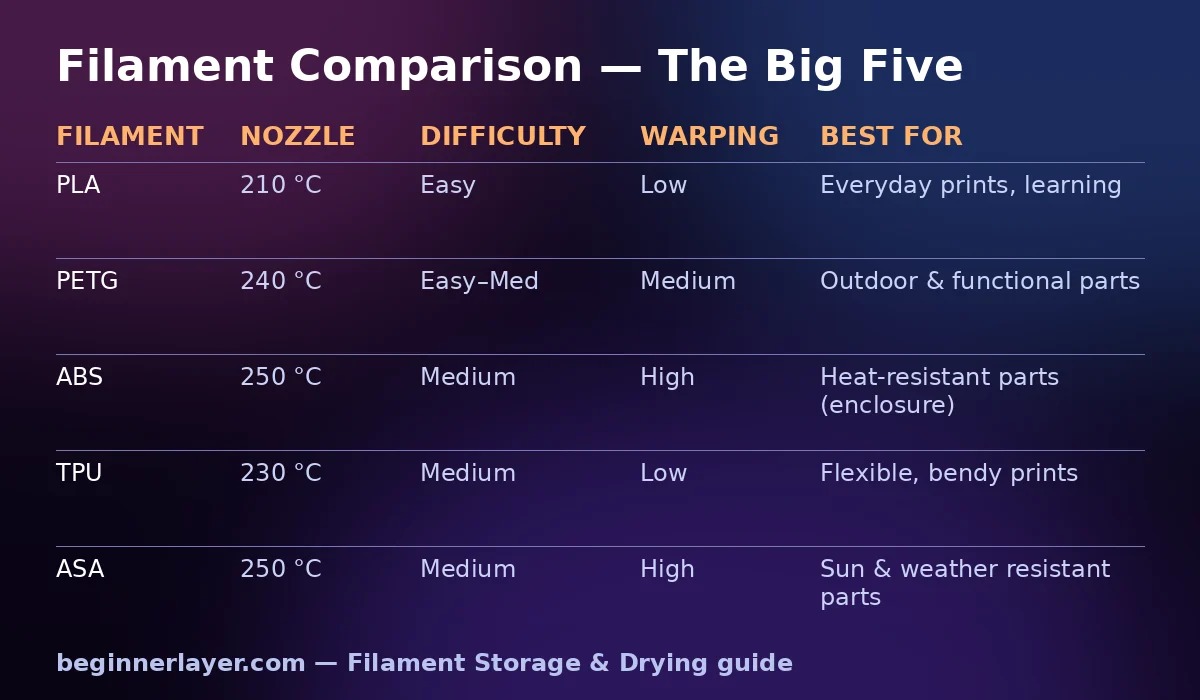
Common mistakes
- Storing spools on an open shelf 'because PLA doesn't absorb water' — it does, just slower.
- Drying in an unverified oven at 'the lowest setting' and fusing a spool solid.
- Throwing a thimble of desiccant into a leaky box and trusting it for a year.
- Troubleshooting settings for days before drying a spool that crackles.
- Drying once and storing open again — the clock restarts immediately.
Printable quick-fix summary
- Listen: pops/crackles at the nozzle = wet filament.
- Dry: PLA 45–50 °C · PETG 55–65 °C · TPU 50–55 °C · Nylon 70–80 °C, 4–6 h (nylon 8–12).
- Store sealed with silica gel, hygrometer under 20% RH.
- Recharge desiccant when the colour changes.
- Label spools: arrival date + last dried date.
Print this box (the page is print-styled for it) and keep it by the printer.
Opens the print dialog — choose “Save as PDF” and you get this guide as a clean BeginnerLayer PDF, masthead and all.
Questions people ask
How do I know my filament is wet without a dryer test?
Listen for popping at the nozzle and look for a rough, matte surface with excess stringing on a spool that used to print cleanly. That combination is wet filament until proven otherwise.
Is a dry box necessary if I print every day?
For PLA in a dry climate, you can outrun absorption for a while. For PETG, TPU or nylon — or any humid room — yes, a dry box is the difference between tuning once and tuning forever.
Can I dry filament on the printer's bed?
Yes: spool on the bed, cardboard box over it with a vent hole, bed at 45–55 °C for PLA/PETG, several hours. Crude, effective, and free.
How long does a dried spool stay dry on the shelf?
In open room air, days to weeks depending on material and humidity — nylon can re-wet in a day. In a sealed dry box, months.